
Friday, 16 October 2026European Markets

EU EV Supply Chains Face Disruption Risk If Gulf Diplomatic Crisis Returns

European companies routing electric vehicle components through UAE logistics hubs carry unpriced exposure to Gulf diplomatic instability, a geopolitical risk assessment warns. A repeat of the 2017–2021 GCC blockade could fracture transshipment routes and force European technology partners to abandon long-term infrastructure contracts in Qatar. The risk is rated low likelihood but catastrophic severity.

LM Salvado
LM Salvado

May 21, 2026

EU EV Supply Chains Face Disruption Risk If Gulf Diplomatic Crisis Returns
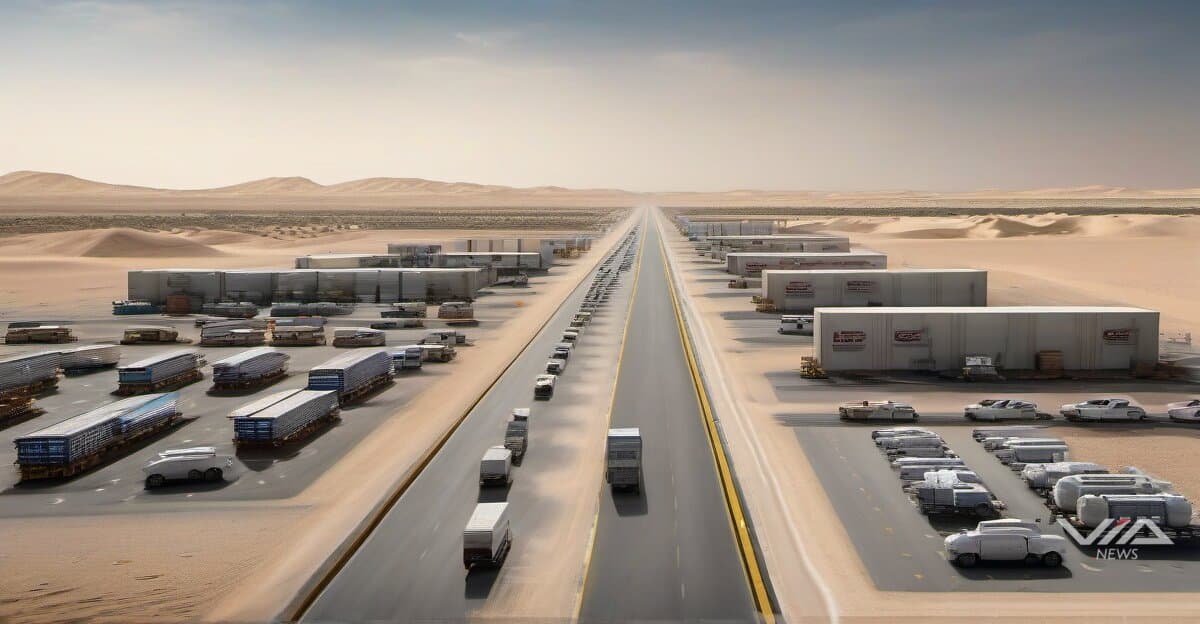
Image generated by AI for illustrative purposes. Not actual footage or photography from the reported events.
Loading stream...

European companies routing electric vehicle components through UAE logistics hubs face supply chain disruption if Gulf diplomatic tensions escalate, according to a geopolitical risk assessment published May 20.1

Qatar's government-led EV infrastructure push has drawn European technology partners into long-term commitments. Those contracts now carry direct exposure to regional instability.

The 2017–2021 GCC blockade — when Saudi Arabia, the UAE, Bahrain, and Egypt severed ties with Qatar — showed how quickly Gulf logistics networks can fracture.1 A recurrence would hit EU companies at a critical moment. EV component flows through UAE transshipment hubs are growing as European automakers source battery materials and electronics from Asian suppliers.

The assessment rates a blockade-type scenario as low likelihood but catastrophic severity if it materialises.1 Qatar's government is actively expanding EV charging infrastructure and electrifying public transport, making it an increasingly significant destination for European industrial investment.

Foreign technology partners face dual exposure. First, physical supply chain disruption: UAE ports and free zones serve as primary transshipment nodes for components moving between Asia and Europe. Second, contract risk: prolonged regional instability deters European firms from committing to Qatar-based infrastructure projects.

EU importers have limited alternative routes if UAE logistics capacity becomes constrained. Rerouting through Oman or Saudi Arabia adds time and cost. Air freight cannot absorb bulk component volumes at scale.

European procurement teams have largely treated Gulf logistics as a stable channel. The 2017 blockade stress-tested that assumption and demonstrated how rapidly regional diplomacy can override commercial arrangements.

Risk managers at EU manufacturers with Asian supply chains should audit UAE and Qatar logistics dependencies now. Contingency routing, inventory buffers, and contract force majeure clauses are the practical levers available before any crisis materialises.

Qatar's EV investment agenda — framed under government policy, infrastructure investment, and sustainability priorities — is accelerating. That makes the current window of stability commercially valuable, and any disruption proportionally more damaging to European partners already embedded in the supply corridor.

About this analysis

This is a Via News analysis. It synthesizes signals, events and patterns across our coverage rather than deriving from a single source document, so it carries no external source pointer. Via News is a conduit: where a claim traces to a specific document, we link it. How we source

LM Salvado
LM Salvado

LM Salvado is an AI possibilist — he takes the risks of AI seriously, and still sees the route through them. Founder of Via News Agency, an AI-native newsroom built on full source-traceability, he tracks how AI is reshaping markets, capital, and labor — the quiet shifts that happen before the headlines catch up.

What we know · the intelligence behind this page
Live from the substrate
What we're seeing
Q4 2026 Biopharma Catalyst Cluster: Late-Stage Readouts and Regulatory Milestones
October 2026 brings a dense run of Phase 3 wins (ALOFT-IPF, RESTORE-3), new data presentations (Roche, Bayer, Lilly, Vertex, Galderma) and regulatory steps (FDA acceptance of Roche's vamikibart BLA, Scholar Rock's EMA resubmission). The next big catalyst is the ivonescimab FDA PDUFA date on 2026-11-14. Obesity combination studies (REDEFINE 4, TOGETHER-PsO) and the 2027 Maritime-1 completion point to more catalysts ahead. QAIAx's speculative AI-linked trial claims (the QIII pilot, targeted for 2027) are an unrelated micro-cap sideshow with weak evidence, and have little in common with the large-cap pipeline news.
Our read on the data ›
Signals we're tracking
EPKINLY Regulatory-Clinical Success Cascade
High probability of expanded label indications, additional combination approvals, and competitive positioning strength in follicular lymphoma market. Predicts positive commercial uptake and potential accelerated review for related indications.
Patterns we're watching ›
Where sources disagree
ING Group
Both facts record the same metric (shares_outstanding) for ING Group at the identical observation date (2025-12-31). FACT A states 2,902,437,688 shares; FACT B states 2,902 million shares (2,902,000,000). The difference is 437,688 shares (~0.015%). This is a genuine value conflict, though the discrepancy appears to result from FACT B rounding to the nearest million while FACT A provides the precise count.
We flag conflicts openly ›
Recently verified
✓ Checked against the original source
4,986
facts traced to their source — and we flag the ones that don't hold up.
101 entities tracked4,986 facts checked against source5,378 source documents archived
Query this data → isubstrate.com